KINETIKA LAB
A progressive, evolutionary and generational artistic series.
Kinetika
The Kinetika series began as a radical inquiry into perception, movement, and identity—an exploration of how images, bodies, and consciousness interact within a continuously shifting field of relations. Emerging from Jamin’s longstanding engagement with street art, stencil-based imagery, and experimental material processes, Kinetika was conceived as a way to push beyond static representations, moving toward something relational, responsive, and unstable.
Its roots lie in the early 2010s when Jamin—already a pioneer of Tasmanian street art and muralism—began incorporating lenticular imaging techniques into his practice. Inspired by the disruptive properties of optical illusions, camouflage, and the dynamic interplay between figure and ground, he sought to create works that would refuse singularity, instead activating a field of multiple potentialities. This search was grounded in his deep study of assemblage theory, fugitive identity, and proprioception, ideas that would later form the core of his PhD research.
The first fully realized work in the series, Kinetika I: Entity, was exhibited at Moonah Arts Centre in 2015. It was a departure from conventional stencil art, transforming the act of viewing into an embodied experience—a negotiation between perception and the artwork’s shifting material conditions. This early iteration established a foundational approach: layered, hybrid forms that exist in states of becoming rather than being.
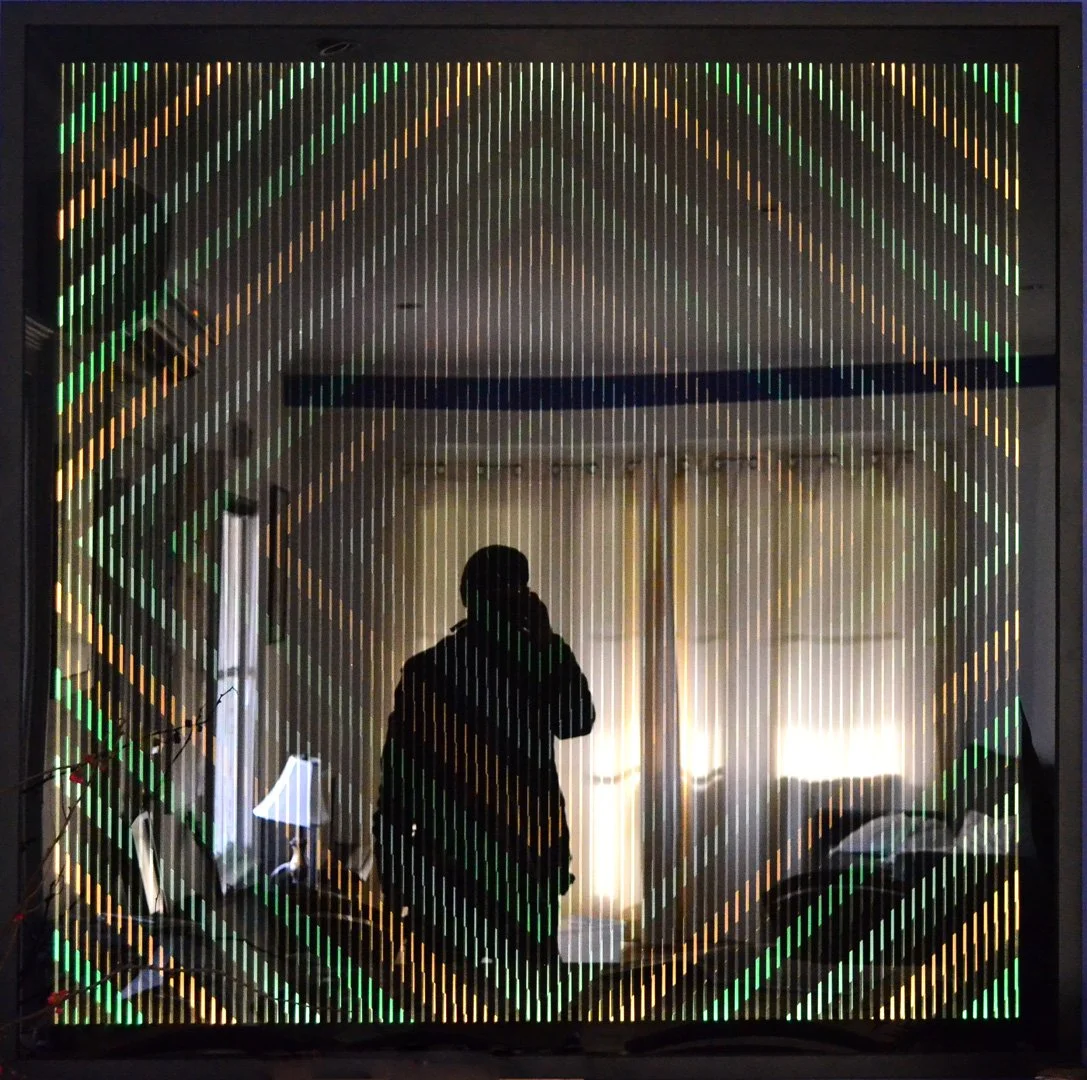
Kinetika I: Entity, Jamin / Dr. Benjamin Kluss, 2015, Spray Paint, ACP, Acrylic Glass, LED Components, 120 x 120cm
KINETIKA I: ENTITY
Kinetika I: Entity marked the inception of a transformative body of work that interrogates perception, identity, and movement through lenticular dynamics. Exhibited at Moonah Arts Centre (MAC) in 2015, this pioneering artwork established the foundational principles of the Kinetika series—exploring the interplay between virtuality and materiality, observer and observed, the static and the shifting.
At its core, Entity functions as a mask in perpetual flux, activating disruption patterns that shift with the viewer’s position, dissolving and reconstituting form in real-time. This fluidity challenged fixed notions of selfhood, proposing instead that identity exists in a state of continual camouflage—a relational construct shaped by motion, context, and engagement.
As the progenitor of the Kinetika lineage, Entity introduced key concerns that would evolve in successive iterations, or generations. Later works expanded on its perceptual instability, incorporating increasingly sophisticated lenticular layering, enhanced spatial complexity, and, ultimately, towards AI-driven interactions. With Kinetika I, the groundwork was laid for a series that would continuously reconfigure itself, pushing deeper into the ontology of masking, becoming, and emergent form. It was not merely an artwork but an initiating gesture—an entity that gestured toward the unknown, setting the trajectory for an expanding field of inquiry.
Evolution: The Expanding Series
Kinetika II – IV: Expanding Perception
Following the success of Kinetika I, subsequent works in the series explored increasingly complex relationships between motion, light, and observer positioning. Kinetika II (QVMAG, 2017) introduced a more intricate interplay of stencil layers, creating deeper parallax effects and allowing for a stronger disruption of visual stability. These works expanded on the affective potential of lenticular imagery, experimenting with degrees of distortion, delay, and non-linearity.
Kinetika III (Despard Gallery, 2017) and Kinetika IV (Contemporary Art Tasmania, 2018) moved toward immersive environments, shifting from framed pieces to installation-based works. These later iterations transformed the entire spatial experience of the viewer, utilizing controlled lighting and reflective surfaces to heighten the illusion of movement and transformation. They also introduced a stronger philosophical dimension, drawing from Deleuzian multiplicities and quantum perception, situating Kinetika within broader discourses on the instability of identity and the malleability of reality.

Kinetika II: A, Jamin / Dr. Benjamin Kluss, 2017, MDF, paper, LED lights, 240 x 360cm; QVMAG, Launceston

Kinetika III: Atlas, Jamin / Dr. Benjamin Kluss, 2017, ACP, Acrylic Mirror, 120 x 120cm x 5cm

Kinetika II: B, Jamin / Dr. Benjamin Kluss, 2017, MDF, paper, LED lights, 240 x 360cm; QVMAG, Launceston

Kinetika V (works in series), Jamin / Dr. Benjamin Kluss, 2018, Spray Paint, ACP, 120 x 120 x 5cm; BoAA, Ballarat
Kinetika V – VI: A Language of Emergence
By the time Kinetika V was presented at the Biennale of Australian Art (BoAA) in 2018, the work had evolved into a more complex system of visual instability and gestural fluidity. Here, the lenticular layers were no longer simply reacting to an observer’s position; they were actively creating the illusion of depth, disappearance, and emergence—as though the image was in a constant state of self-generation.
Kinetika VI (Flinders Lane Gallery, 2019) marked a key conceptual shift. No longer purely an experiment in material and optics, this iteration introduced the notion of intelligence—not just in terms of how the work “perceived” its viewer, but how it might begin to learn from and respond to its environment. This marked the transition from a perceptual system to an emergent one, opening the door for what would become the AI-enhanced Kinetika.
Kinetika VII: UMWELT & Fugitive Identity
The culmination of this phase of the series, Kinetika VII, was exhibited as part of Jamin’s PhD submission (Fugitive Identity, Plimsoll Gallery, 2019). This was not only a continuation of earlier investigations but an articulation of the conceptual underpinning of the series—a manifesto of sorts.
Here, the ideas of proprioception, masking, and relational becoming were explicitly framed within an academic discourse, situating Kinetika as a critical intervention into how identity is felt, constructed, and dissolved.
In this iteration, camouflage became not just a visual strategy but an ontological condition—a method of survival, a means of engagement, and a mechanism for transformation. The works disrupted the expectation of fixed meaning, encouraging the audience to participate in the act of identity formation, mirroring the ways in which subjectivity is constantly negotiated in real-world contexts.

Kinetika VII: Umwelt, Jamin / Dr. Benjamin Kluss, 2019, MDF, paper, LED, wood, 240 x 500 x 500cm; Plimsoll Gallery, Hobart
Kinetika VII: Umwelt, Jamin / Dr. Benjamin Kluss, 2019, MDF, paper, LED, wood, 240 x 500 x 500cm; Plimsoll Gallery, Hobart